
What is Anyflo Pay
Anyflo Pay is a neutral orchestration layer for stablecoin payments. One integration lets your application accept, send, and settle in any major stablecoin across any supported blockchain without you ever managing liquidity, bridges, FX, or chain-specific gas.
For institutions, fintechs, and platforms moving money, stablecoins provide a programmable way to make payments. But the ecosystem is fragmented: every chain holds different inventory, every issuer has different reach, every wallet expects a different format. Anyflo Pay abstracts that fragmentation.
What you get
- One API for sending and receiving payments across supported assets and chains.
- Any-to-any routing — receive USDC on Base, settle in USDsui on Sui, no manual bridging.
- Price competition through a solver network that bids on orders based on the source or destination amount.
- Embedded compliance — KYT, sanctions, and travel rule checks happen inside the orchestration layer.
- No custody footprint — Anyflo Pay never takes principal; funds move solver-to-recipient.
How it works
Every payment on Anyflo Pay flows through three phases: intent, solve, and settle.
1. Intent
Your application creates an Order describing what should happen: the amount, the asset the sender wants to pay in, and the asset and chain the recipient should receive. You don’t specify the route. Intent is declarative.
2. Solve
The order is broadcast to Anyflo Pay’s solver network through the Solver Hub, which communicates with solvers using REST and WebSocket. For in orders, solvers bid on the destination amount. For out orders, they bid on the source amount. Anyflo collects bids and selects a solver, who must accept the order before payment.
3. Settle
After the solver accepts, the sender deposits funds on the source chain using signed payment instructions. The deposit is confirmed on-chain, and the solver delivers funds to the recipient on the destination chain. The indexer confirms delivery, and the order becomes delivered. Anyflo Pay holds no escrow.
Why this matters: the application specifies the payment outcome. Solvers handle execution using their liquidity on the destination chain, while Anyflo Pay coordinates the order and monitors the on-chain deposit and delivery.
System overview
Who is it for
- Retail & eCommerce — businesses integrating stablecoin payments into checkout and payment flows.
- Fintechs & neobanks — platforms embedding stablecoin transfers and payouts into their applications.
- Payroll & Contractors — businesses paying employees and contractors in stablecoins across supported chains.
- Marketplaces — platforms enabling stablecoin payouts to sellers and service providers.
Core concepts
Orders
An Order is the primary object in Anyflo Pay. It represents one party’s intent to move stablecoin value to another party.
An order is a request to send currency C1 from a sender’s address A1 on blockchain B1 (the source) to a recipient’s address A2 on blockchain B2, in currency C2 (the destination).
Order types
There are two order types: in and out.
in— specifies the amount of source currencyC1to send to the destination.out— specifies the amount of destination currencyC2that must be delivered to the recipient.
Lifecycle
Orders progress through the following lifecycle states:
new— the order has been submitted by the customer app.bidding— the order has been validated and broadcast to solvers and is collecting bids.selected— the winning solver has been selected, and the order is awaiting the solver’s acceptance.accepted— the solver has acknowledged the order, and the customer has been informed to proceed with payment.executing— the deposit has been confirmed on-chain, and the solver is executing the transfer to the recipient.delivered— the indexer has confirmed the solver’s delivery transaction on the destination chain.rejected— the order failed validation or was blocked by the Compliance Policy Engine.expired— no bids were received within the bidding window, or solver acceptance timed out with no remaining bidders to reassign the order to.cancelled— the customer cancelled the order before payment. Cancellation is available fromnew,bidding,selected, andaccepted.
Order flow diagram
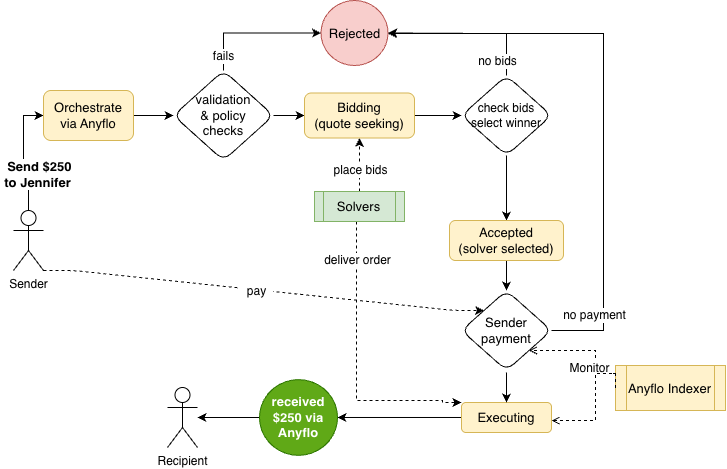
Intent architecture
Anyflo Pay separates what a user wants to happen from how it gets executed.
In traditional transaction routing, the application specifies the execution path, including exchanges, bridges, smart contracts, and intermediary liquidity pools. With an intent-based model, the application specifies the outcome instead.
Your application expresses intent through an order that defines the source, destination, and amount to send or deliver. Anyflo Pay validates the order and broadcasts it to solvers. Solvers bid on the order, and the selected solver delivers the destination funds to the recipient.
Why intents matter
- Integration — adding new blockchains or assets requires no structural changes to the client-facing API.
- Price competition — for
inorders, solvers compete to deliver the highest destination amount. Foroutorders, they compete to require the lowest source amount. - Solver reassignment — if the selected solver does not accept before the deadline, the system tries the next bidder. If no bidders remain, the order expires.
Solver network
Solvers are the liquidity providers that execute orders. The solver network is where the actual value movement happens.
How solving works
Anyflo Pay’s Solver Hub communicates with authorized solvers through REST and WebSocket. After compliance checks and fee calculation, Anyflo broadcasts the order and collects bids during a 1.5-second bidding window.
Anyflo selects a solver, who must accept the order before the customer proceeds with payment. Once the deposit is confirmed on-chain, the solver delivers the destination funds to the recipient. Learn about liquidity-provider participation and the integration quick start.
Solver characteristics
- Liquidity — solvers use their existing stablecoin inventory on the destination chain to deliver funds to the recipient.
- Participation — the network is permissioned, with requirements for legal vetting, compliance, and legal agreements with liquidity providers.
Supported assets
Stablecoins
Asset coverage expands continuously.
| Asset | Issuer | Status |
|---|---|---|
USDC | Circle | SUPPORTED |
USDT | Tether | SUPPORTED |
USDsui* | Sui-native | SUPPORTED |
suiUSDe | Ethena × Sui | Coming soon |
AUSD | Agora | Coming soon |
FDUSD | First Digital | Coming soon |
PYUSD | PayPal / Paxos | Coming soon |
RLUSD | Ripple | Coming soon |
* USDsui is supported on Sui only.
Blockchains
Anyflo Pay handles gas, RPC connections, and wallet formats across chains, so you don’t need to integrate with each chain separately.
| Chain | Status |
|---|---|
| Sui | SUPPORTED |
| Base | SUPPORTED |
| Polygon | SUPPORTED |
| Arbitrum | SUPPORTED |
| Ethereum | WORK IN PROGRESS |
| Avalanche | WORK IN PROGRESS |
| HyperEVM | WORK IN PROGRESS |
| Arc | WORK IN PROGRESS |
| Tron | WORK IN PROGRESS |
| Solana | Coming soon |
| BNB Chain | Coming soon |
| TON | Coming soon |